The AI Partner Framework | PrplJennifer
An Original Framework by Jennifer Gildea  ·  PrplJennifer

The AI Partner Framework

AI works best when it knows its role — and so do you. A phase-by-phase map of where AI leads, and where your expertise is irreplaceable.

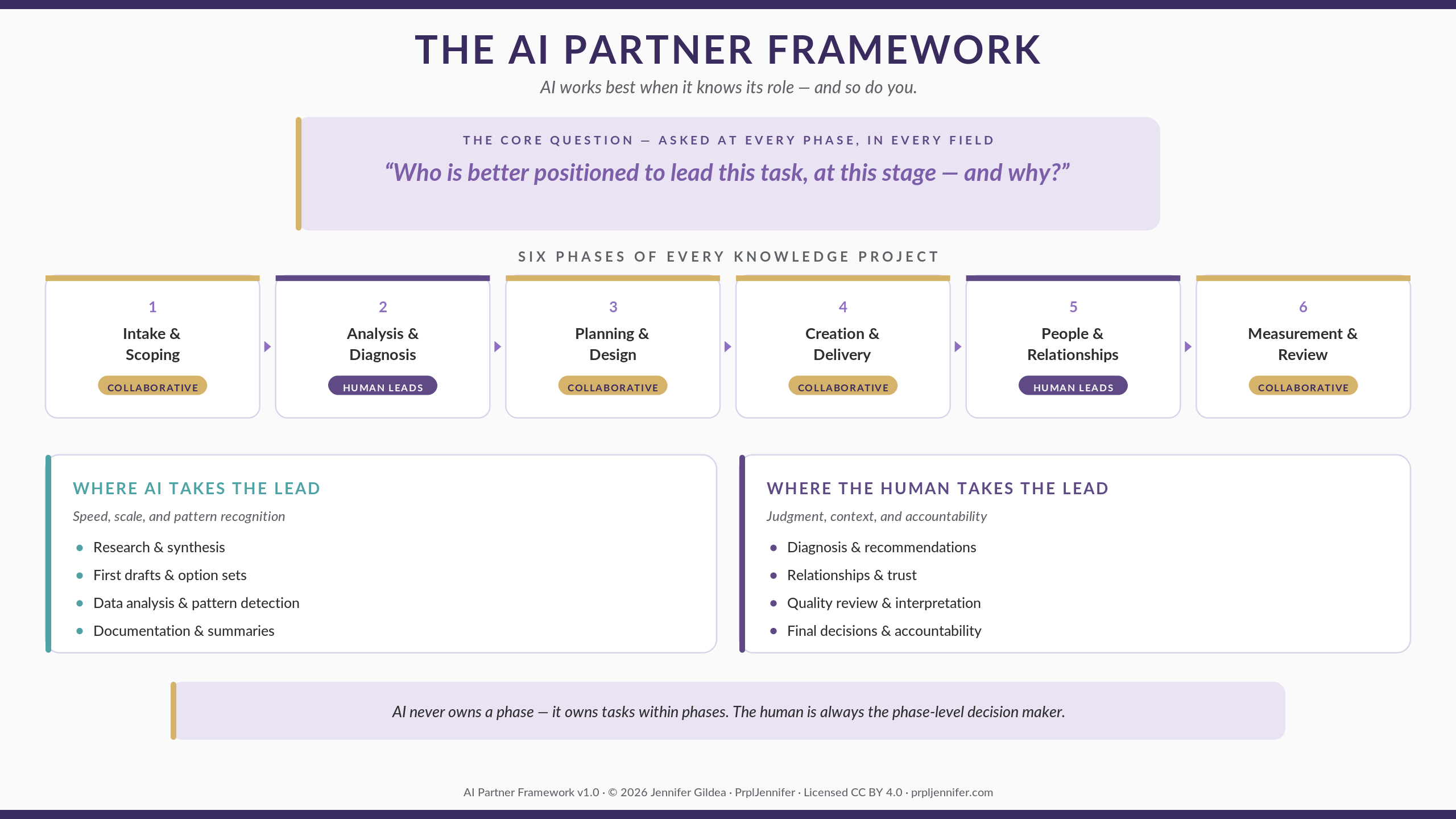
The Core Question
Who is better positioned
to lead this task,
at this stage — and why?

Asked at every phase of every project, across every knowledge discipline.

🤖 AI Leads Speed, scale, pattern recognition, and first-draft generation
🧠 Human Leads Judgment, context, relationships, and accountability
What It Is

A Partnership Model,
Not a Replacement Story

Every complex knowledge project moves through a predictable lifecycle — from intake to delivery to measurement. At each stage, there are tasks where AI is the stronger partner, and tasks where human judgment is non-negotiable.

The AI Partner Framework maps that distinction — not as a rule, but as a thinking tool that any knowledge worker can apply to their own field.

AI accelerates where breadth and speed matter Research, drafts, synthesis, pattern detection, documentation, option generation
⚖️
Humans lead where judgment and context matter Diagnosis, recommendation, relationships, quality control, strategic interpretation
The Generic Lifecycle

Six Phases. One Partnership Question at Each.

The phase names change by field. The question never does.

📋
Intake & Scoping Collaborative
🔍
Analysis & Diagnosis Human Leads
🎯
Planning & Design Collaborative
✍️
Creation & Delivery Collaborative
🤝
People & Relationships Human Leads
📊
Measurement & Review Collaborative
AI Leads — AI drives this task
Human Leads — human expertise required
Collaborative — AI drafts, human decides

Why no “AI Leads” phases? In knowledge work, AI never owns a phase — it owns tasks within phases. Every phase contains at least one judgment moment that belongs to the human. This is the core claim of the AI Partner Framework: AI is a powerful task-level partner, but the human is always the phase-level decision maker.

Task Taxonomy

What Each Partner Does Best

The split isn’t about capability — it’s about what each phase of the work actually requires.

🤖
Where AI Takes the Lead
Speed, scale, and pattern recognition
Research & Synthesis
Background research Data synthesis Pattern detection Competitive analysis
Generation & Drafting
First drafts Option sets Templates Documentation
Analysis & Review
Data analysis Sentiment scanning Content freshness Prep materials
The principle: If the task rewards breadth, speed, or volume — and the output will be reviewed before it matters — AI is the stronger partner.
🧠
Where the Human Takes the Lead
Judgment, context, and accountability
Diagnosis & Recommendation
Root cause analysis Go / no-go decisions Strategic recommendation
Relationships & Navigation
Stakeholder trust Political navigation Difficult conversations Presence
Quality & Interpretation
Accuracy review Contextual judgment Causal interpretation Ethical oversight
The principle: If the task requires organizational context, lived experience, accountability, or a relationship — the human is irreplaceable.
Field Applications

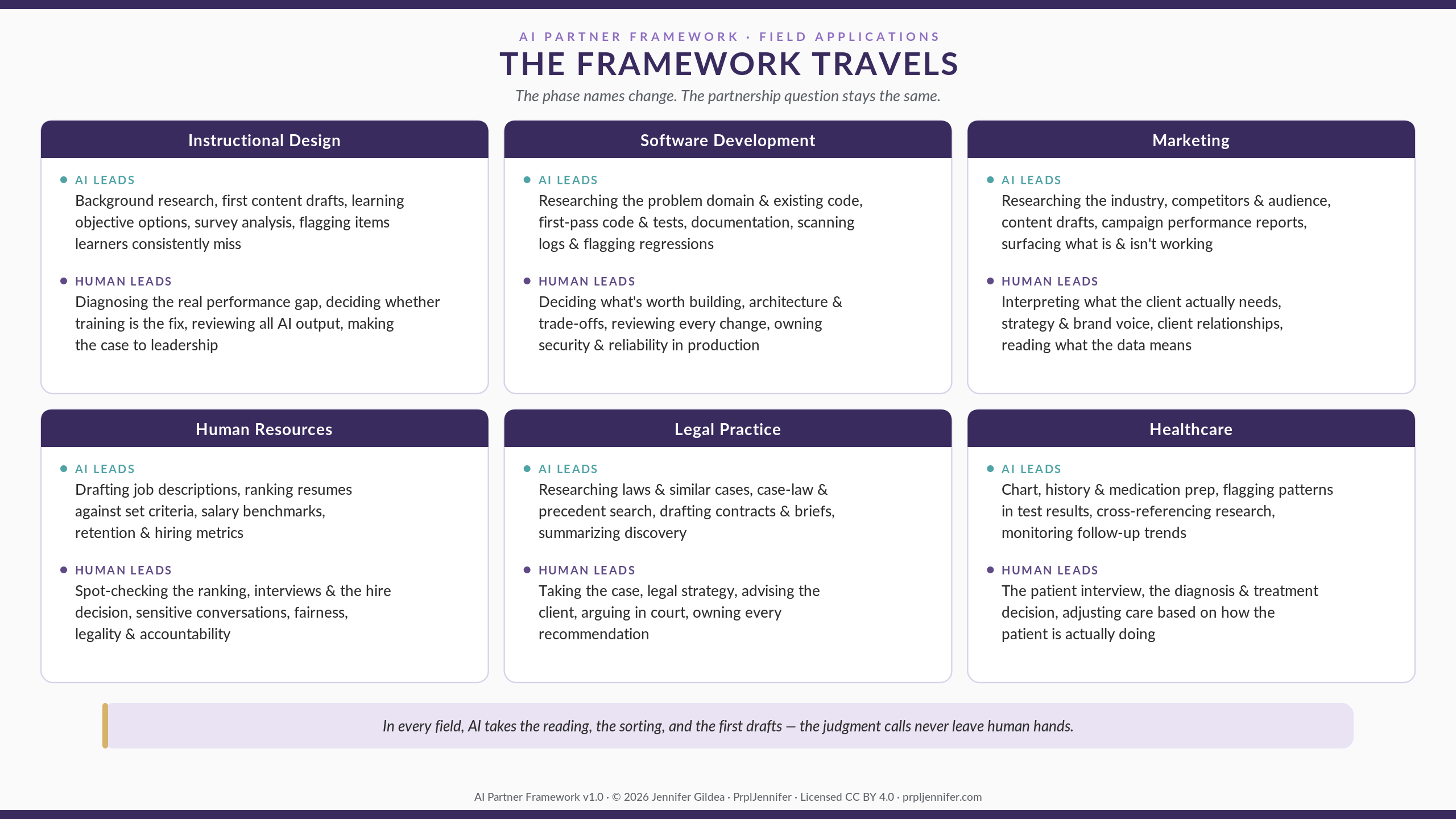
The Framework Travels

The phase names change. The partnership question stays the same.

📚 Instructional Design
AI: Background research, first content drafts, learning objective options
Human: Diagnosing the real performance gap, reviewing all AI output for accuracy
Human: Deciding whether training is actually the right solution
AI: Analyzing survey responses, flagging which assessment items learners consistently miss
Human: Interpreting whether behavior actually changed — and why
Human: Making the case to leadership in language that connects to business results
💻 Software Development
AI: Researching the problem domain, existing solutions, and the current codebase before planning begins
Human: Talking with users and stakeholders and deciding what’s actually worth building
AI: Generating first-pass code and tests, summarizing legacy systems, drafting documentation
Human: Designing the architecture, weighing trade-offs, reviewing every change before it ships
Human: Owning accountability for security, reliability, and what the code does in production
AI: Scanning logs and error reports, flagging regressions, drafting release notes
Human: Deciding what the bugs and metrics actually mean — and what gets built next
📣 Marketing
AI: Researching the client’s industry, competitors, and audience before the briefing
Human: Running the briefing meeting and interpreting what the client actually needs — which is often different from what they asked for
AI: Audience research, content drafts, campaign performance reports
Human: Setting the strategy, maintaining the brand voice, managing client relationships
AI: Pulling performance metrics and surfacing what is and isn’t working
Human: Reading what the data actually means for the strategy and having that conversation with the client
🤝 Human Resources
AI: Drafting job descriptions, ranking resumes against defined criteria, researching salary benchmarks
Human: Setting the criteria, spot-checking the ranking, choosing candidates, and interviewing – the hire decision is always human
AI: Drafting policies and onboarding materials, summarizing engagement survey data
Human: Handling sensitive conversations — performance issues, conflicts, accommodations, departures
Human: Owning accountability for fair, legal, and ethical decisions about people
AI: Tracking retention and hiring metrics, flagging patterns in feedback and turnover
Human: Interpreting what those patterns mean for culture — and acting on them

Notice the pattern. In every field, AI takes the reading, the sorting, and the first drafts. The diagnosis, the relationships, the judgment calls, and the accountability never leave human hands. AI didn’t shrink the human role — it moved it up. The work that’s left is the work that always needed you most.

TAKE IT WITH YOU

The framework works best when it’s in the room. Download a slide for your next deck or team conversation.

⬇ The AI Partner Framework — one-slide overview (PNG)
⬇ The Framework Travels — six field examples (PNG)
Scroll to Top